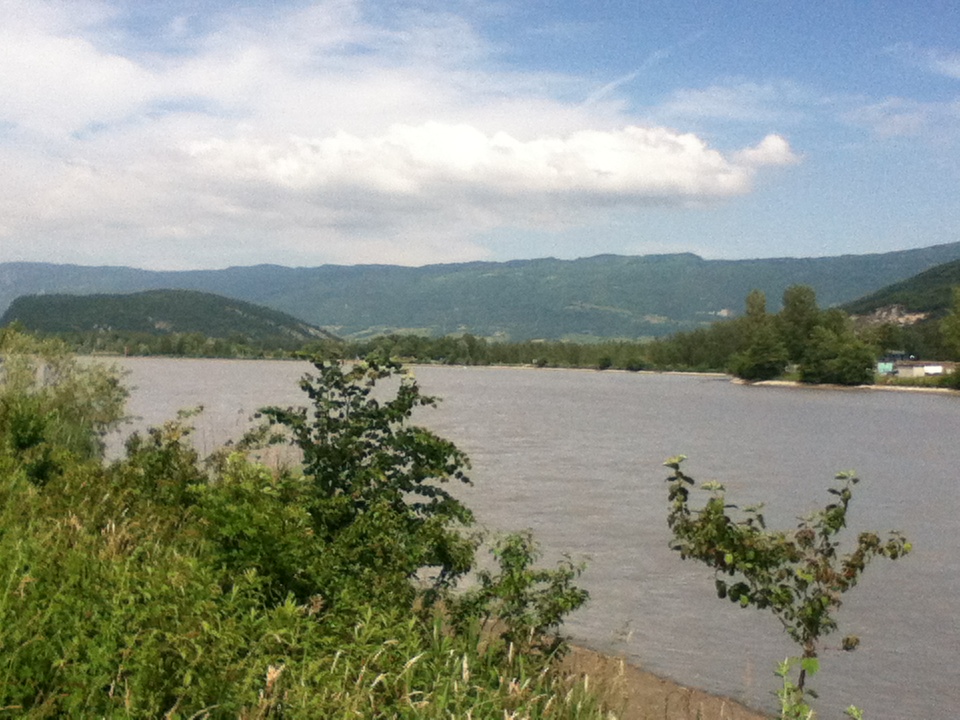
The next
morning we resumed our journey. The Rhône widens at Lyon and assumes an even more industrial and
commercial aspect, laden with long freight barges. This isn’t surprising – for millennia it has
been a highway between the Mediterranean world and the heart of what is now
France. As far as possible we stayed
close to the river, but our way was often blocked by industrial plants like oil
refineries. As with the Mississippi in
the United States, the banks were reinforced by large levees that it was hard
to see over.

When we
reached the city of Vienne, there occurred one of those serendipities that make
travel worthwhile. A wrong exit off the
motorway put us on a road running along the eastern bank of the river. Not really knowing where we were, we took the
first right, which put us on a bridge over the Rhône.
To our right on the western bank stood a large modernist building
surrounded by open fields, which I suddenly realized – I was acting as co-pilot
and had been responsible for the wrong turning – that the fields looked unmistakably like archaeological ruins.
We hadn’t
realized that Vienne has a sister museum to the one in Lyon, with even more
extensive exhibits and Roman ruins. As
soon as we managed to turn around and find a parking place we knew that our
plans for the day would have to be revised – we had a good morning’s work ahead
of us.
 |
| Model of Roman Vienne |
The museum at Saint-Romain-en-Gal, located across the river from the
town of Vienne, is a state-of-the-art establishment, with excellent explanatory
displays that take full advantage of a treasure trove of artifacts uncovered in
the area, many through recent excavations on the site. It seems that this was an even larger Roman city
than Lyon, a major port and administrative center.


Because the lands on the western bank had not
been developed in later years it was possible to excavate a large section of
the former Roman city, including storehouses, shops and extensive villas owned
by wealthy merchants. Many of the
exquisite mosaics that had decorated their rooms were recovered and displayed,
as well as some amazing wall paintings.

After exhausting
the museum we walked the ruins themselves and attempted to imagine what life in those
villas – with their open court-yards, shady arbors and reflecting pools – might
have been like.

And then we returned to
the museum building for a pleasant lunch at a restaurant overlooking the
river.

 Afterward we
explored Vienne proper, which had some impressive Roman buildings intermingled
with later developments, including a church with a nice Romanesque
cloister. An impressive temple dedicated
to Augustus and his wife Livia stood opposite a line of busy shops; farther up
the hill there was another amphitheater.
We were beginning to agree with the opinion that France has more and
better Roman ruins than Italy itself.
Afterward we
explored Vienne proper, which had some impressive Roman buildings intermingled
with later developments, including a church with a nice Romanesque
cloister. An impressive temple dedicated
to Augustus and his wife Livia stood opposite a line of busy shops; farther up
the hill there was another amphitheater.
We were beginning to agree with the opinion that France has more and
better Roman ruins than Italy itself. Having spent
the better part of the day in Vienne, we hastened to our next destination. Leaving the Rhône, we drove southeast to the Côtes du Rhône region where we planned to spend
some time getting reacquainted with our favorite wines. During our last visit to Provence several
years ago, we happened to drive by the Hôtel Les Florets, an attractive
country hotel in the foothills of the Dentelles de Montmirail above the village
of Gigondas. We had reserved a table on
the terrace overlooking vine-covered hillsides and had one of the most
memorable dinners of our lives. So,
while planning our Rhône adventure we were determined to
return and stay there.
Having spent
the better part of the day in Vienne, we hastened to our next destination. Leaving the Rhône, we drove southeast to the Côtes du Rhône region where we planned to spend
some time getting reacquainted with our favorite wines. During our last visit to Provence several
years ago, we happened to drive by the Hôtel Les Florets, an attractive
country hotel in the foothills of the Dentelles de Montmirail above the village
of Gigondas. We had reserved a table on
the terrace overlooking vine-covered hillsides and had one of the most
memorable dinners of our lives. So,
while planning our Rhône adventure we were determined to
return and stay there.
We were not
disappointed. Even though the weather
was a bit rainy and cool, the hotel was a perfect place to reconnect with the
Provençal countryside that we love, with its dry pine-covered hills
that always remind me of southern California.
The hotel’s terrace with its
stunning views was the perfect place for a pre-dinner aperitif, even if it was
too cool to eat outside. The food was
every bit as good as we’d remembered, and we enjoyed the chance to explore
further its extensive wine list. We picked
the brains of the sommelier, who happened to be the innkeeper who had checked us in
and who we met again the next day cleaning the swimming pool. Foremost among our discoveries was how much
we enjoyed the Muscat grown in nearby Beaumes-de-Venise, even though we’d never
liked sweet wines before.

 The next day
was Sunday, and because of our experience with Switzerland’s strict Sunday
closing laws we were afraid we would miss the chance to visit the local wine
cellars. Hence we were pleased to find
that all the shops in Gigondas would open for business after lunch. After a walk through the hilltop village we
had a tasting-menu lunch (a series of small tapas-style bites paired with different wines) and visited a number of caveaus to partake of
free samples of their wares. We came away
with quite a nice collection for our cellar.
The next day
was Sunday, and because of our experience with Switzerland’s strict Sunday
closing laws we were afraid we would miss the chance to visit the local wine
cellars. Hence we were pleased to find
that all the shops in Gigondas would open for business after lunch. After a walk through the hilltop village we
had a tasting-menu lunch (a series of small tapas-style bites paired with different wines) and visited a number of caveaus to partake of
free samples of their wares. We came away
with quite a nice collection for our cellar.
On Monday we
were back on the road, returning to the Rhône after a swing through
Beaumes-de-Venise to pick up some of the afore-mentioned Muscat. We passed by the city of Avignon, site of the
Papal palace for much of the 14th
century, but didn’t stop because we’d visited before in long-ago graduate
student days. Once more we diverged from
the river to head toward the town of St. Rémy-de-Provence where another major
Roman site awaited us.

Hard on the
heels of our tours of Lyon and Vienne, our visit to the ruins of the city of Glanum firmly cemented our understanding of the sweep and power of the Roman world
in this part of France. Glanum was
founded in the 6th century BC by a Celto-Ligurian tribe on the site
of a healing spring in the foothills of the Alpilles; beside the spring was a
shrine to the Celtic god Glanis. Trade
with the Greek colony of Marseilles about 90 kilometers to the south brought
Hellenistic influences that can be seen in remains of houses, shops and
shrines. In the 1st century
BC the Romans attacked and leveled these and gradually reconstructed the city
in their image.

They erected a massive
triumphal arch at the entrance to the city near the end of the reign of
Augustus – it clearly promotes acculturation to the Roman way by contrasting
Celts in chains with free men in Roman garb. Nearby is a monumental mausoleum to the Julii family. Within the city itself the Romans constructed
ever-larger buildings – a forum, baths, temples – atop the ruins of the
previous buildings.
In turn,
however, the city was overrun by the Alamanni in 260 AD and subsequently
abandoned. Over the centuries its
buildings were dismantled to provide stones for a new village on the plain that
became St. Rémy. Only the monuments
on the edge of the city survived; known as “Les Antiques” they became a must-see
for travelers on the Grand Tour. In the
1920s, sustained archaeological excavations began to decipher the layers of
previous civilizations.

Today the
ruins stand in a large sun-baked park flanked on one side by an olive grove and
on the other by the rocky outcroppings of the Alpilles. It was hot but fascinating work to move back
and forth between the Celtic, Hellenic and Roman layers. Surrounded by the dry crags of the hills the
area seemed to exist in a dimension beyond time.

Yet once we
had finished there was little time left to visit the other attraction standing
on the other side of the olive grove – the Monastery of St. Paul-de-Mausole,
with its attached mental hospital where Vincent van Gogh resided for a year
near the end of his life. The site draws
many visitors eager to view the room where he ostensibly lived, but it is a
reconstruction. We were actually more
interested in visiting the Monastery’s Romanesque church and cloister. But as we left the sight of olive trees in
late-afternoon light reminded us of the source of some of van Gogh’s work
during his stay.


Our hotel
afforded a wonderful view of the Alpilles and we enjoyed exploring the old town
with its maze of narrow streets encircled by a broad café-lined boulevard. During our two nights there we had pleasant
dinners but enjoyed most the time spent sitting at a café under the stars.

But we still
had yet to complete our mission to follow the Rhône to its end. On our last day before returning home we drove
through the Alpilles, past the impressive cliff-top castle ruins of Les Baux,
to rejoin the Rhône at Arles. As it nears the Mediterranean, the river
divides into two branches (the large and small), the land in between a large
marshy delta called the Camargue. Parts
of the wetlands have been turned into rice fields, and there are vast
evaporation beds from which sea salt is extracted. But much of the area is a protected Nature
Park where wildlife flourishes, from flamingos and wild boars to white horses.

But we began to realize that this wasn’t going to be so easily done, because our road diverged to the west and ended at a broad beach a couple of miles from the river. Having been assured by a guide at a local nature area that we could walk to the river from there, we parked the car and set out eastward on foot.

After we had
walked along the beach for about a mile, we encountered another challenge to
our mission, in the form of a large warning sign:
 | |
| Nudist Beach: Here one lives nude |
It seems
that the rest of the area was reserved for nudists. Alarmed, we
debated the wisdom of continuing. But,
seeing that there were few people around we decided to venture forth, keeping
our eyes averted when necessary.


Feeling
satisfied that we had done what we set out to do, we returned to St. Rémy for the night and drove back to Switzerland the next
day. Because I was feeling homesick for
the mountains we headed northwest into the French Alps. We lunched in the charming city of Gap and
passed through Grenoble on our way home.
I’m not sure
I can say that we learned a particular lesson in tracing the Rhône from its origin in an Alpine glacier to its end. But in the process we gained further
appreciation for the many-layered history of the region – and a nice little
collection of Côtes du Rhône wine.